
Much has transpired since the last Agronomy Notes, we have had a few storms move through with rain, spotty hail and wind. Soybeans have started blossoming and are in the reproductive phase (R), just in time to see Soybean Aphids show up as well as a few diseases. Corn has put on 4-6 collars and is approaching V14 for a mid-April planting date and is some areas was over 6 feet tall on the 4th of July.
Soybean plant development is from Germinating for some replanted beans due to drown outs, as well as second crop after peas to Full Bloom (R2) for most everything else that was planted in April or May.
We are starting to see Soybean Aphids show up in fields bordered by trees or woodlands. (This makes sense in that the Soybean Aphids overwinter in Buckthorn plants which are commonly found in wooded areas.) We generally also see Soybean Aphids sooner, and in higher numbers in fields that are lower in Potash (K).
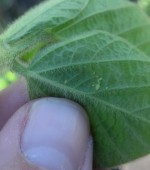
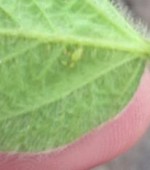
We are also starting to see the potential early stages of Brown Spot in the lower leaves as well as Bacterial Blight in the upper leaves.
Because soybean plants are phototropic (light sensitive) they will start the flowering process shortly after longest day of the year or the shortest night which was June 21. Soybean plants can start the flowing process from V2 –V8, depending on the growing season. Because soybean plants will start flowering at V2, you need to raise your planting rate if you are planting Soybeans in mid to late June or early July so the emerged plants will emerge from the soil competing for light, which forces the plants to become taller when the start to bloom, which makes it easier to harvest and also adds to the potential for more yield.
Once soybean plants start the flowering process they are in the reproductive stage and all growth phases from here on out will be listed in the R stage (example R1, R2 etc…). Soybeans will continue to put on vegetative growth or V stage as they begin the flowering stage and it is not uncommon for some agronomists to stage some early flowering plants in both the vegetative and reproductive stages (example V8 and R1).
As the soybean plant blooms and puts on vegetative growth the root system is also growing rapidly. In ideal growing conditions it is not uncommon to find soybean roots 2-3 feet deep and 18-24 inches in width. Because of the adequate to abundant moisture we have received so far this year the soybean roots have not had to work to find moisture, and will not be as deep or wide because of it.
Soybean nodulation which starts at V1 is increased dramatically at the R2 growth stage and will peak at R5.5 (beginning seed to full seed) and will cease shortly after R5.5. If you have excess nitrogen in the soil the soybean plant will decrease the number of nodules it produces and subsequently the amount of Nitrogen from nodulation that is available to the plant.
Corn plant development ranges from V10 for corn planted in late May to V14 for corn planted in mid- April.
| 20-Jun | Planting Date | GDU’S | Plant Stage | Growth Stage |
| 15-Apr | 764.5 | Collar on Ninth Leaf | V9 | |
| 23-Apr | 716.5 | Collar on Eighth Leaf | V8 | |
| 30-Apr | 682.5 | Collar on Seventh to Eighth Leaf | V7-V8 | |
| 08-May | 585 | Collar on Sixth to Seventh Leaf | V6-V7 | |
| 27-Jun | Planting Date | GDU’S | Plant Stage | Growth Stage |
| 15-Apr | 903 | Collar on Eleventh to Twelfth Leaf | V11-V12 | |
| 23-Apr | 855 | Collar on Tenth to Eleventh Leaf | V10-V11 | |
| 30-Apr | 821 | Collar on Tenth Leaf | V10 | |
| 08-May | 723.5 | Collar on Eighth Leaf | V8-V9 | |
| 04-Jul | Planting Date | GDU’S | Plant Stage | Growth Stage |
| 15-Apr | 1023 | Collar on Fourteenth Leaf | V14 | |
| 23-Apr | 975 | Collar on Thirteenth Leaf | V13 | |
| 30-Apr | 941 | Collar on Twelfth Leaf | V12 | |
| 08-May | 843.5 | Collar on Tenth to Eleventh Leaf | V10-V11 |
We accumulated 395 Growing Degree Units (GDU’s) from June 14th to July 4th, with the breakdown by week as follows:
- 136.5 GDU’s for the week of June 14 to June 20
- 138.5 GDU’s for the week of June 21 to June 27
- 120 GDU’s for the week of June 28 to July 4
The comparisons for GDU’s by and day and week for this time frame is as follows:
| Dates | 2015 GDU/Day | 30 Year GDU Average/Day | Difference/Day |
| June 14-20 | 19.50 | 18.00 | 1.50 |
| June 21-27 | 19.79 | 19.86 | -0.07 |
| June 28-July 4 | 17.14 | 19.86 | -2.71 |
| June 1-30 | 18.73 | 17.70 | 1.03 |
| Dates | 2015 GDU/Week | 30 Year GDU Average | Difference |
| June 14-20 | 136.5 | 126 | 10.5 |
| June 21-27 | 138.5 | 139 | -0.5 |
| June 28-July 4 | 120 | 139 | -19 |
| June 1-30 | 562 | 531 | 31 |
As you can see we ended June slightly below average for GDU’s but the month as a whole we were 31 GDU’s more than the 30 year average. At this point in the growing season we are very close to the 30 year average for GDU’s for all planting dates.
With the abundant moisture we have received so far we are starting to see the start of some diseases like Common Eye Spot and I also believe Northern Corn Leaf Blight. In talking with other Agronomists in Iowa they are seeing high levels of these diseases and will be spraying fungicides to help combat them.
Upcoming Events:
- Central Advantage Plot Meriden July 14-15th
- Waseca and Dodge County Fair July 15-19th
- Central Advantage Plot Kenyon July 16-17th
- Rice County Fair July 21-26
- Central Advantage Plot Blooming Prairie July 22-23rd **Date Change***
Social Media: Find us on Facebook https://www.facebook.com/pages/Central-Valley-Cooperative/1417488761867155 and also on Twitter at https://twitter.com/CvCoop1. If you are having problems with the links, please see the www.centralvalleycoop.com homepage to like us on Facebook or follow us on twitter.
Central Valley Website: Past Central Valley Agronomy Notes and Agronomy Topics of the week can be found on our website www.centralvalleycoop.com under the Agronomy page.
If you have been receiving our Agronomy Notes or Agronomic Topics of the week via mail and now have an email address and want them emailed to you, contact your local Central Valley Agronomist or myself at [email protected] and we will get you on the list. Use the same procedure if you would like to be taken off this mailing.
