

News
“Shot Holing” update by Brian Weller
In the last few days were have been seeing more “Shot Holing” from European Corn Borer (ECB) in fields of Conventional and non Bt hybrids.
ECB larvae will tunnel or bore into the leaf prior to the leaf unfurling, once the leaf unfurls it will show a line of holes or “Shot Holing” in the leaf surface. These holes will disrupt the plants ability to move nutrients and water, as well as increase the potential for more disease issues in the plant. In later stages of plant development, ECB will tunnel or bore into the stalk which will increase the likelihood of stalk lodging during harvest.


One ECB larvae tunneling in a plant prior to tassel can reduce yield 6-8%.
Agronomy Update Hop Vine and Common Stalk Borer
In the last few days Central Valley Agronomists and Interns have found Hop Vine Borer (pictured below and on the left) and also Common Stalk Borer (pictured below and on the right) in fields of Conventional and herbicide resistant corn. (Pictures courtesy of Dalton Kampsen, summer intern in the Ellendale location)

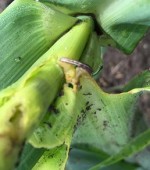
Hop Vine Borer and Common Stalk Borer are generally found on field edges or fields with large amounts of crop residue (reduced tillage). In the past I have normally found Common Stalk Borer in fields with heavy Giant Ragweed pressure especially after we have sprayed the Giant Ragweed plants the Borer will start to transition from the Giant Ragweed to the Corn plant.
Hop Vine Borer and Common Stalk Borer will tunnel into the plant and start to eat towards the growing point, by doing this it will kill the newest leaves and create a plant that has a green lower leaves but dead leaves at the center or “Dead Heart Plants”, this does kill the plant.
If your hybrids have SmartStax, VT Triple Pro or Agrisure Viptera in it you do have a level of protection from these pests. With that being said even with this built in protection, if we have heavy infestations of Hop Vine Borer or Common Stalk Borer they can overwhelm the plant. The concern here is that the pest needs to ingest part of the plant before control will be achieved, if enough pests ingest the plant, the plant will be overrun. The analogy is you might have food for 50 people but if 150 people come to eat you will run out of food fast.
Treatment levels for Hop Vine Borer and Common Stalk Borer are 10 % of the plants at the V6-V7 growth stage. I have seen Fields with high Giant Ragweed pressure with corn at V8 that needed to be treated.
If you have questions or concerns regarding Hop Vine Borer or Common Stalk Borer contact myself or your local Central Valley Agronomist.
Agronomy Notes for the Weeks Ending May 30, June 6 and 13th, 2015
Much has transpired since the last Agronomy Notes, Corn has put on 4-5 collars and is approaching V8 for a mid-April planting date and is 19” tall at that collar with total plant height knee high or 24-25” tall. Some of the early planted soybeans have put on 3-4 growth stages and are almost 8” tall with some of the replanted soybeans still poking through.
Corn plant development is from V4 on corn planted in early May to almost V8 for corn planted in mid-April. We are still seeing signs of slow emergence from the spring, either from slightly less than ideal planting conditions in certain areas of the field, poor seed to soil contact as well as germination differences within hybrids.
Morning Field Update by Brian Weller, Lead Agronomist
In looking at fields this morning (6/15/15) I did notice more instances of Rapid Growth Syndrome (RGS) which is also known as buggy whipping or onion leafing, affected plants have tightly rolled leaves at the whorl that do not unfurl right away, and may be wrapped so tightly that the plant will bend in some case almost perpendicular to the ground. The leaves of affected plants normally unfurl in a day or two, but can take as long as a week. Once these leaves unfurl you will notice a light green or yellow leaf, this is normal occurrence and is caused by the lack of photosynthesis of those leaves while they were wrapped up. These leaves will green up in a day or two and the only evidence of having been wrapped up will be a crinkled type of appearance on some of the leaves.
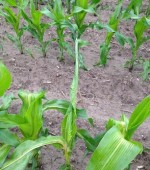
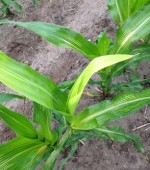
This phenomenon normally happens when we have cooler temperatures and cloudy days or slower growing conditions followed by very rapid growth conditions. I almost always see rainfall during those days preceding the buggy whipping. It has been my experience that plants that have had sandblasting earlier in the growing season and have had dirt in the whorl will are more prone to show buggy whipping symptoms.
During a growing season you may also see something similar symptoms if you have had a hail damage on plants. Those of us who while growing up were more prone to getting our weather forecast from a radio, television or newspaper and not our phones, are more likely to remember seeing these type of symptoms after an application of Growth Regulator Herbicide (Dicamba, or 2,4-D) especially if those types of products were applied closer to V5 or later.
In most instances plants affected by Rapid Growth Syndrome do not have a yield reduction.
Update on Armyworm
In the last day Central Valley Agronomists have come across a few fields of Conventional and herbicide resistant corn have been attacked by Armyworm.
Armyworm Moths tend to lay their eggs in grassy areas, (Small Grain, CRP fields, ditches, corn fields with heavy grass pressure) and tend to prefer to eat grass when the larvae hatch. I have been told by several sources that Armyworm will attack the grass in a broadleaf crop (Soybean, Sunflower) and leave the broadleaf crop alone.
Fields or areas that I would be scouting would be:
- Small Grain
- Sweet Corn
- Conventional Corn
- Fields with a History of Grass issues
- Small Grain or Grass Cover Crops
- Refuge Corn (No Insect Resistance, straight Roundup or Liberty)
- Ditches or Field Margins
Armyworm larvae tend to be more nocturnal and will tend to congregate in the whorl of corn plants but will also hid in crop residue during the day. This tends to make them a little more difficult to find.
If your corn is SmartStax or has Herculex (Unless Herculex RW/RR2 or HerculexRW) in it you do have a level of protection from Armyworm. Other traits that offer protection are Genuity VT Double PRO and Triple PRO, but some of the older genetics that offer YieldGard VT Triple are susceptible to Armyworm. Please check with your local Central Valley Agronomist to clarify the level of protection against Armyworms your hybrids have.
Even with built in protection in the plant, if we have a heavy infestation of Armyworm as we have recently encountered it could overwhelm the plant even with that protection. The concern here is that the pest needs to ingest part of the plant before control will be achieved, if enough pests ingest the plant, the plant will be overrun. The analogy is you might have food for 50 people but if 150 people come to eat you will run out of food fast.
Treatment levels in Small Grain fields are 4-5 larvae/square foot after the plants have been shook. Treatment levels for corn are when 25% of plants have 2 larvae in the whorl or when 75% of plants have 1 larvae or more.
The potential reason for this influx of Armyworm is that our cool spring may have been detrimental to the flies and wasps that feed on Armyworm larvae as well as fungal or virus’s that tend to infect larvae in warmer environments.
Again if you have more questions regarding Armyworms contact your local Central Valley Agronomist
Agronomy Notes week ending May 23rd, 2015
We started the week with temperatures in the mid to upper 60’s°F and some scattered rainfall and gusty winds on Sunday followed by dropping temperatures and cloudy weather into Tuesday morning. Temperatures dropped enough that on Tuesday morning we may have experienced some very light scattered frost. (I have not seen any frost damage yet, but have seen some wind and/or sandblasting damage as well as some Silver Leaf Corn Syndrome.)
Soil Temperatures fluctuated from 42°F-84°F at the 2” depth and 45°F-75°F at the 4” depth with soil temperatures at the 8” depth ranging 49°F-65°F
| Depth | Soil Temperature | Average |
| 2″ | 42°F-84°F | 63°F |
| 4″ | 45°F-75°F | 60°F |
| 8″ | 49°F-65°F | 57°F |
Precision Information for Maximum Returns
What do the following words or phrases have in common? Sustainability, Environmental Impact, In-Season product purchases, Maximize nutrient usage, Return on Investment, Increase profits and yields, Growers taking a leadership role, In-house team of experts, Local Data, Big Data, Time tested, Manage your risk, Measure, Verify and Real-Time Decision Making.
The words and phrases listed above all describe actions and/or the results of enrolling you’re acres in Central Advantage! The downward pressure on per acre margins has resulted in a renewed interest in Return on Investment (ROI) and nothing creates, analyzes and records ROI like Central Advantage. With Central Advantage you will drill down to the most important level of ROI – per bushel ROI. With so many factors effecting your bottom line, the Real-Time Decisions you make throughout the growing season, have the ability to make or break the profitability for that field or farm. Central Advantage has been recording, organizing and storing local data since 2003. Twelve years of data that has and is being queried with the sole purpose of increasing the probability of decisions you make having a positive outcome.
For example: What has been the average response to v5 fungicide on a certain soil type or with a certain hybrid? Do the K levels matter? What about in a wet year? Dry year? Should I put a stabilizer in my side-dress nitrogen? What has been the response to Nitrate Now? With Learning blocks we have and continue to prove our applications by limiting the variables and isolating our tests within zones of productivity!
The questions are limited only by your imagination and the answers are in the data base waiting to be discussed in an actionable and understandable way. In addition to our agronomist we have 6 highly trained Precision Ag specialists ready to give you one on one recommendations along with fast efficient service. There are many new entrants into the Precision Ag/Big Data space. Don’t be fooled by imitators. The Central Advantage program was built in our trade area with your soils and environmental variables.
See one of our professional agronomist and signup for Central Advantage and Nitrate Now! Precision Information for Maximum Return.
Agronomy Notes for the Week Ending May 16, 2015
We started the week with temperatures in the mid 50’s°F and some scattered rainfall on Sunday and ended with some warmer temperatures and scattered showers. With the wind we have been receiving the soil has been drying out allowing some tillage and planting to get finalized. The old adage that if it rains on Easter Sunday you will receive rain for Seven Sundays is holding true for the most part.
Soil Temperatures fluctuated from 43°F-80°F at the 2” depth and 46°F-70°F at the 4” depth with soil temperatures at the 8” depth ranging 49°F-62°F.
| Depth | Soil Temperature | Average |
| 2″ | 43°F-80°F | 61.5°F |
| 4″ | 46°F-70°F | 58°F |
| 8″ | 49°F-62°F | 55.5°F |
Soil temperatures at the 20” depth were in the mid 50°F’s and at the 40” depth were in the upper 40°F. (Soil temperature information is both Central Valley and University of Minnesota SROC in Waseca data.)
Agronomy Notes for the Week Ending May 9, 2015
We started the week with some warmer temperatures on Sunday followed by some very spotty rainfall and hail later in the day and into the evening hours. The old adage that if it rains on Easter Sunday you will receive rain for Seven Sundays is holding true for the most part. It seemed as though there were spotty scattered showers throughout the area all week with rain amounts varying from .01 to 1” or more.
Air temperatures ranged from 41°F to 87°F with temperatures moderating as the week progressed. Wednesday and Thursday were on the breezy side that helped dry the soil out which allowed a few planters to get back into the field later in the week.
